




Every year on 15th August, India celebrates its Independence Day—a day that reminds us of our nation’s journey from freedom to progress. Over the past several decades, India has transformed into one of the world’s fastest-growing economies through continuous investments in infrastructure, manufacturing, transportation, and urban development.
While towering bridges, highways, metro systems, industrial plants, and smart cities are visible symbols of this progress, there are countless engineering components working behind the scenes to make these projects possible. One such essential component is the Electric Resistance Welded (ERW) pipe.
In this Independence Day special, let’s explore how ERW pipes have become an integral part of India’s infrastructure and industrial growth.
India’s Infrastructure Journey Since Independence
Following independence in 1947, India faced the enormous challenge of building a modern nation. The country’s focus was on developing reliable transportation networks, expanding irrigation systems, establishing industrial zones, improving public utilities, and creating stronger urban infrastructure.
Over the years, landmark initiatives such as:
- National Highway Development
- Smart Cities Mission
- Jal Jeevan Mission
- Make in India
- Industrial Corridors
- Railway Modernization
- Urban Water Supply Projects
have accelerated India’s development. Each of these projects relies heavily on durable steel products—and ERW pipes are among the most widely used.
What Are ERW Pipes?
ERW (Electric Resistance Welded) pipes are manufactured by forming steel coils into a cylindrical shape and welding the edges together using high-frequency electric resistance. This process creates a strong, uniform, and reliable weld without the need for additional filler material.
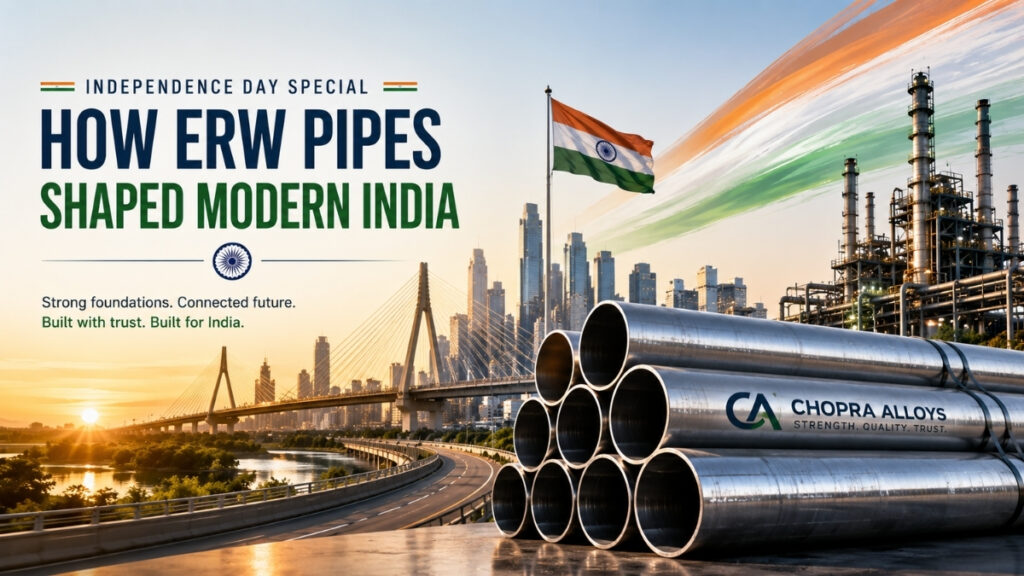
ERW pipes are known for:
- High dimensional accuracy
- Excellent strength and durability
- Smooth surface finish
- Cost-effective manufacturing
- Consistent quality
- Long service life
These advantages make them suitable for a wide range of industrial and infrastructure applications.
How ERW Pipes Have Shaped Modern India
1. Building Strong Water Infrastructure
Access to clean water is essential for every community. ERW pipes are widely used in water transmission and distribution networks, municipal pipelines, irrigation systems, and wastewater management projects.
As India expands its water infrastructure, quality ERW pipes continue to support efficient and reliable water delivery.
2. Supporting India’s Oil & Gas Sector
India’s growing energy needs require dependable pipeline infrastructure. ERW pipes are extensively used for transporting oil, natural gas, and industrial fluids across processing plants, refineries, and distribution networks.
Their strength and reliability make them an important part of the country’s energy ecosystem.
3. Strengthening Construction and Infrastructure
From commercial buildings to industrial facilities, ERW pipes are used in structural frameworks, scaffolding, fabrication, roofing structures, warehouses, airports, and bridges.
Their precision and load-bearing capability make them a preferred choice for modern construction.
4. Powering Industrial Growth
Manufacturing industries rely on ERW pipes for machinery, process pipelines, material handling systems, fabrication work, and plant infrastructure.
As India’s manufacturing sector continues to expand, ERW pipes remain an essential industrial material.
5. Enabling Transportation Networks
Roadways, railways, metro systems, ports, and airports all require robust steel components. ERW pipes contribute to guardrails, structural supports, drainage systems, utility conduits, and various engineering applications that keep transportation networks running efficiently.
Why Quality Matters
Infrastructure projects are long-term investments. The performance of every project depends on the quality of the materials used.
High-quality ERW pipes provide:
- Superior strength
- Excellent weld integrity
- Corrosion resistance
- Dimensional consistency
- Long operational life
- Reduced maintenance costs
- Reliable performance under demanding conditions
Choosing a trusted manufacturer ensures that every pipe meets stringent quality standards and performs reliably for years.
The Future of ERW Pipes in India
India’s vision for the future includes smart cities, sustainable infrastructure, renewable energy, industrial expansion, and improved public utilities. As these sectors continue to grow, the demand for precision-engineered ERW pipes will only increase.
With advancements in manufacturing technology and quality control, ERW pipes will continue to play a critical role in building a stronger, safer, and more connected India.
Chopra Alloys Pvt Ltd: Supporting India’s Growth
At Chopra Alloys Pvt Ltd, we are proud to contribute to India’s infrastructure journey by supplying high-quality ERW pipes that meet the evolving needs of construction, manufacturing, engineering, and industrial projects.
Our commitment to quality, precision, and customer satisfaction enables us to deliver products that help build lasting infrastructure across the nation.
Conclusion
India’s Independence is not only a celebration of freedom but also a celebration of progress, innovation, and resilience. Behind every successful infrastructure project are reliable engineering materials that make development possible.
ERW pipes may often remain unseen, but their contribution to India’s highways, industries, water systems, energy networks, and urban development is immense.
This Independence Day, let us celebrate the spirit of nation-building and recognize the role that quality steel products play in shaping a stronger India.
Happy Independence Day from Chopra Alloys! 🇮🇳
Together, let’s continue building the infrastructure that powers India’s future.
