




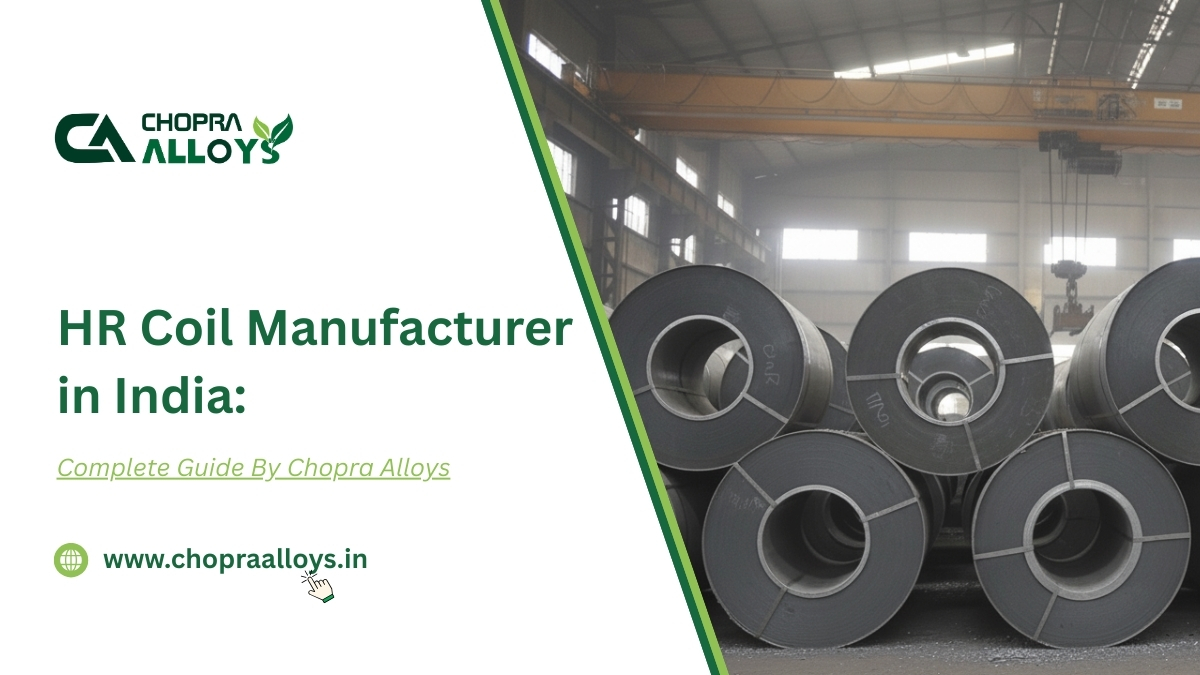
Hot Rolled (HR) coils are one of the most important raw materials used in steel manufacturing, infrastructure development, and industrial production across India. From structural fabrication to pipe manufacturing, HR coils play a critical role in delivering strength, durability, and performance.
In this guide, we explain what HR coils are, their manufacturing process, grades, applications, and how to choose the right HR coil manufacturer in India for your industrial needs.
What Are HR Coils?
HR coils (Hot Rolled coils) are steel sheets rolled at high temperatures, typically above 1700°F (927°C). At this temperature, steel becomes malleable and can be shaped easily into coils of various thicknesses and widths.
After rolling, the steel is cooled naturally and wound into coils for easy transportation and further processing.
Key Characteristics of HR Coils
- High Strength & Structural Stability
HR coils offer excellent mechanical strength, making them suitable for load-bearing and heavy-duty applications. - Superior Weldability
Their chemical composition allows smooth welding, which is essential for pipe manufacturing and structural fabrication. - Good Formability & Machinability
HR coils can be easily cut, bent, and shaped, making them ideal for industrial processing. - Cost-Effective for Large-Scale Production
Due to the hot rolling process, HR coils are more economical compared to cold rolled steel, especially for structural use. - Wide Range of Thickness & Width Options
Available in multiple dimensions to meet diverse industrial and construction requirements.
Major Applications of HR Coils
HR coils serve as a primary raw material across various industries, including:
- ERW Pipe Manufacturing – Used for producing round, square, and rectangular steel pipes.
- Structural Sections & Beams – Essential for buildings, bridges, and industrial sheds.
- Automotive Components – Used in chassis parts and structural frameworks.
- Industrial Fabrication – Machinery frames, equipment bases, and heavy structures.
- Construction & Infrastructure Projects – Widely used in large-scale development projects across India.
Manufacturing Process of HR Coils
The production of HR coils involves several stages:
1. Heating
Steel slabs are heated in a reheating furnace to high temperatures.
2. Rolling
The heated slab passes through rolling mills where it is compressed and reduced in thickness.
3. Finishing
The steel strip is shaped to the desired thickness and width.
4. Cooling & Coiling
The rolled strip is cooled and wound into coils.
This process ensures uniform thickness and mechanical properties suitable for industrial use.
Common Grades of HR Coils in India
HR coils are manufactured in various grades depending on application requirements.
Some common grades include:
- IS 2062 (E250, E350) – Structural applications
- SAILMA grades – High strength structural use
- ASTM A36 – General structural steel
- API grades – Pipe manufacturing
Choosing the correct grade depends on:
- Load-bearing requirements
- Welding needs
- Structural application
- Environmental conditions
Applications of HR Coils in India
HR coils are widely used across industries due to their strength and affordability.
1. ERW Pipe Manufacturing
HR coils are the primary raw material for manufacturing ERW steel pipes used in construction and infrastructure.
2. Construction & Infrastructure
Used in beams, columns, bridges, and structural frameworks.
3. Automotive Industry
Manufactured into chassis components and structural parts.
4. Industrial Fabrication
Used in heavy machinery, equipment frames, and industrial sheds.
5. Shipbuilding & Railways
Utilized in structural and load-bearing applications.
Why Choose a Reliable HR Coil Manufacturer in India?
Selecting the right HR coil supplier in India ensures:
- Consistent thickness and width accuracy
- Compliance with IS and ASTM standards
- High tensile strength
- Proper surface quality
- On-time bulk supply
A trusted HR coil manufacturer follows strict quality control, mechanical testing, and chemical analysis before dispatch.
Factors to Consider When Choosing an HR Coil Supplier
Before finalizing a supplier, consider:
✔ Quality Standards & Compliance
Ensure the HR coils comply with recognized standards such as IS 2062 (E250, E350) or relevant ASTM specifications. Certified material guarantees strength, safety, and long-term structural performance.
✔ Production Capacity & Supply Capability
For infrastructure and industrial projects, timely delivery is critical. Choose an HR coil manufacturer with adequate production capacity and the ability to supply bulk quantities without delays.
✔ Surface Quality & Dimensional Accuracy
Inspect the surface for scaling, rust, cracks, or uneven thickness. Consistent width and thickness ensure better fabrication, welding, and overall structural stability.
✔ Testing, Certification & Documentation
A reliable supplier should provide Mill Test Certificates (MTC), detailing chemical composition and mechanical properties. Proper documentation ensures transparency and compliance with project requirements.
✔ Industry Experience & Market Reputation
Manufacturers with strong industry experience understand project-specific demands, quality expectations, and supply chain management, ensuring dependable service and long-term reliability.
HR Coils vs CR Coils – Basic Difference
| Parameter | HR Coils | CR Coils |
| Rolling Temperature | High | Room temperature |
| Surface Finish | Rougher | Smoother |
| Cost | Lower | Higher |
| Strength | Good | Higher precision |
| Applications | Structural, pipes | Automotive, appliances |
For structural and pipe manufacturing, HR coils are generally preferred due to cost efficiency and strength.
Growing Demand for HR Coils in India
India’s infrastructure expansion, renewable energy projects, and industrial growth have significantly increased demand for HR coils in India. Government initiatives and manufacturing expansion are driving steady growth in the steel sector.
As a result, reliable HR coil manufacturers play a crucial role in supporting construction and engineering industries.
Conclusion
HR coils are a fundamental material in India’s steel and infrastructure ecosystem. From ERW pipe production to large-scale structural and industrial projects, they provide the required strength, flexibility, and cost efficiency that modern construction demands.
When choosing an HR coil manufacturer in India, it is essential to focus on quality standards, production capacity, testing certifications, and industry experience to ensure long-term performance and reliability. Manufacturers like Chopra Alloys, known for their commitment to quality control and consistent supply capabilities, play an important role in supporting infrastructure and industrial growth across the region.
